
English 
Views: 0 Author: Site Editor Publish Time: 2026-10-30 Origin: Site


Modern vehicles offer convenience unimaginable just a few decades ago. Picture a family approaching an SUV with heavy groceries. A simple press of a key fob lifts the power tailgate smoothly. Behind this seamless operation lies a highly reliable, compact DC motor working tirelessly to lift a substantial physical load.
However, these crucial automotive components operate in exceptionally unforgiving environments. The internal mechanisms face freezing winter blizzards, scorching summer heatwaves, constant moisture intrusion, and relentless road vibration. The magnets nestled inside these motors must withstand all these environmental stressors without failing, cracking, or losing their magnetic charge.
This is where Strontium Ferrite emerges as the unsung hero of modern automotive engineering. While the commercial market offers stronger magnetic materials, this specific ceramic compound strikes a scientifically proven balance. It delivers exceptional mechanical durability, unmatched temperature resistance, and vital cost-effectiveness. This unique combination of traits makes it the ultimate choice for engineers designing reliable liftgate systems.
Thermal Stability: The material maintains its critical magnetic properties in extreme temperatures ranging from -40°C to 250°C, an essential requirement for global automotive applications.
Corrosion Resistance: Unlike rare-earth alternatives, this specific ceramic compound does not rust or oxidize. This makes it perfect for moisture-exposed tailgate and trunk cavities.
High Coercivity: It highly resists demagnetization, ensuring the tailgate motor retains its lifting power for the entire operational lifetime of the vehicle.
Cost-Efficiency: It provides exceptionally reliable performance at a fraction of the cost of neodymium magnets, serving as an ideal solution for scalable mass production.
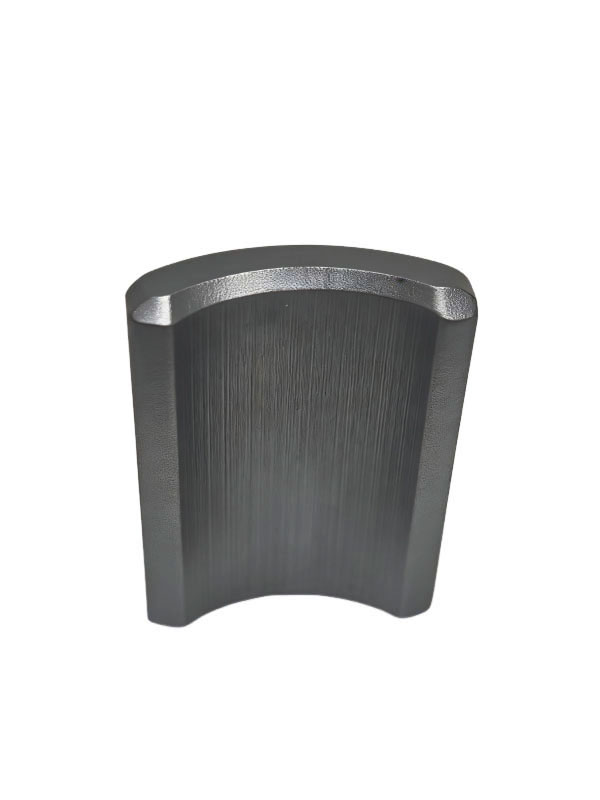
Optimized Design: When precisely shaped, the curved geometry perfectly fits the internal radius of a motor to maximize torque and electrical efficiency.
To truly understand why material selection matters, we must examine how a liftgate motor functions. The internal permanent magnet serves as a critical failure or success point within this automated system.
Power liftgates typically utilize a brushed DC motor integrated into the spindle struts to generate the necessary mechanical force. The working principle here relies entirely on electromagnetism. Inside the motor housing, an electromagnetic coil known as the rotor receives electrical current from the vehicle battery. This creates a temporary, fluctuating magnetic field.
This rotor is surrounded by a permanent DC Motor Magnet acting as the stator. The precise interaction between the fluctuating field of the rotor and the static field of the stator creates rotational force, known as torque. This torque is subsequently transferred through a planetary gearbox and a lead screw. Consequently, it provides the immense pushing power required to raise a heavy metal and glass trunk against the relentless force of gravity.
Components built for vehicles must adhere to incredibly strict engineering standards. The daily physical toll on a tailgate system is immense. Users frequently slam the trunk shut manually. This action sends harsh mechanical shockwaves directly through the strut assembly.
Beyond physical impact, these motors face severe climatic shifts. A black SUV parked on expansive asphalt during a Phoenix summer will experience internal trunk temperatures soaring well above 80°C. In contrast, that same mechanism must fight through frost and thick snow accumulation during a Montreal winter, where temperatures plummet below -30°C. Add in high humidity, corrosive road salt, and fluctuating electrical loads from the alternator, and it becomes clear why sourcing a resilient Automotive Motor Magnet is non-negotiable. If the material degrades under these harsh realities, the motor loses torque, leading to a sluggish or completely stalled power tailgate.
To appreciate its widespread application in vehicles, one must understand the fundamental scientific background of this core material. It is not a metal in the traditional sense, but rather a highly engineered ceramic compound.
Chemically represented as SrFe12O19, this specialized hard ceramic magnet undergoes a precise metallurgical process. First, abundant iron oxide is carefully measured and mixed with strontium carbonate. This raw mixture undergoes calcining, which involves heating the material to extremely high temperatures to initiate a vital chemical reaction.
Following calcination, the resulting compound is milled into a microscopic fine powder. To ensure maximum magnetic strength, this powder is pressed into specific molds while simultaneously exposed to a strong external magnetic field. This crucial step aligns the microscopic magnetic domains in a single direction, creating an anisotropic structure. Finally, the pressed shapes are sintered in massive industrial furnaces at temperatures exceeding 1,200°C. This fuses the loose powder into a solid, dense, and permanent ceramic block.
In the field of magnetism, the term hard does not refer to physical rigidity or brittleness. Instead, it refers to magnetic coercivity. A hard ferrite possesses a remarkably high resistance to demagnetization. Once it is magnetized during the manufacturing process, stripping away its magnetic field is incredibly difficult. This behaves in sharp contrast to soft ferrites such as manganese-zinc, which easily magnetize and demagnetize for use in alternating current applications like electrical transformers. For a permanent motor stator that must provide an unwavering magnetic push, a hard ferrite is absolutely mandatory.
Automotive engineers do not select materials by accident or mere preference. Strontium ferrite consistently beats out competing materials for liftgate applications due to four distinct, highly advantageous properties.
Initiating movement in a heavy tailgate requires a massive surge of initial force. When the motor first engages, especially when pushing upward against gravity or heavy snow, it draws a massive spike in electrical current. This high starting current generates a powerful opposing electromagnetic field within the motor housing.
Weaker magnets would suffer from permanent demagnetization under this intense electrical stress. Strontium ferrite leverages its exceptional intrinsic coercivity to effortlessly resist these opposing fields. It maintains its full original magnetic strength over tens of thousands of operating cycles. This ensures the door opens just as robustly on year ten as it did on day one.
Temperature fluctuations are the ultimate enemy of permanent magnets. As heat increases, molecular agitation causes magnetic domains to fall out of alignment, weakening the overall pull. Strontium ferrite exhibits remarkable thermal stability across a massive temperature band. It operates reliably from -40°C up to 250°C, experiencing minimal reversible flux loss at the higher ends of the spectrum. This thermal resilience guarantees that a tailgate motor will not struggle during a scorching heatwave or fail entirely during a freezing winter night.
Moisture intrusion is inevitable in automotive environments. Rainwater, melting snow, and heavy condensation frequently find their way into door panels and tailgate struts. Many high-strength magnets, particularly those containing rare-earth elements, are highly susceptible to rapid rusting. Once a magnet rusts, it flakes apart and destroys the internal components of the motor.
Because strontium ferrite is essentially an oxide, a ceramic compound made of already-oxidized iron, it is chemically impossible for it to rust. This natural, inherent immunity to corrosion completely eliminates the need for expensive, easily scratched protective platings like nickel or epoxy. Furthermore, it simplifies the motor design and drastically increases long-term reliability.
The global automotive industry operates on razor-thin margins. This requires scalable, budget-friendly components that do not sacrifice quality. Rare-earth magnets are subject to severe price volatility due to complex mining processes and geopolitical constraints. Conversely, strontium ferrite is manufactured using iron oxide, one of the most abundant and inexpensive raw materials on the planet. This allows manufacturers to produce highly reliable automated motors at a fraction of the cost. Consequently, power tailgates have transitioned from luxury-only features to standard equipment on everyday consumer models.
While the chemical composition provides the raw performance, the physical geometry dictates how efficiently that performance is transferred into mechanical work. In modern motors, these magnets are rarely simple blocks.
In automotive applications, the stator is almost exclusively manufactured as a Ferrite Arc Magnet, frequently called a segment magnet. Rather than a flat square, the material is meticulously machined into a curved tile. This specific curvature is engineered to perfectly contour around the cylindrical, spinning rotor of the DC motor.
Magnetic force diminishes rapidly as it travels through the air. By matching the internal radius of the motor housing, the arc shape reduces the air gap between the magnet and the copper coils to a fraction of a millimeter. This tight tolerance drastically reduces magnetic flux leakage. Specifically, it funnels the maximum amount of magnetic energy directly into the rotor to generate rotational force.
Space is a premium commodity in modern vehicle design. Tailgate motors must be compact enough to remain hidden within slim trunk struts or tucked seamlessly into rear side panels without eating into valuable cargo capacity. The optimized geometry of the arc shape allows for a highly compact motor housing. Because the magnetic field is efficiently focused exactly where it is needed, engineers can utilize smaller rotors and tighter housings while still generating the robust torque required to lift heavy doors.
When evaluating materials for automotive engineering, a direct comparison quickly highlights why procurement teams specifically source strontium ferrite over alternative options.
Material Type | Max Operating Temp | Corrosion Resistance | Cost Profile | Toxicity / Eco-Friendliness |
|---|---|---|---|---|
Strontium Ferrite | Up to 250°C | Excellent (No coating needed) | Highly Economical | Non-toxic, Eco-friendly |
Neodymium NdFeB | 80°C to 150°C (requires alloys) | Poor (Requires plating) | High / Volatile | Mining causes eco-concerns |
Barium Ferrite | Up to 250°C | Excellent | Economical | Highly Toxic Heavy Metal |
Neodymium magnets are exponentially stronger than ferrite. Given their immense power, it seems logical to use them to make tailgate motors even smaller. However, for this specific application, neodymium presents critical drawbacks. First, it rusts rapidly when exposed to ambient moisture, requiring multi-layered protective coatings such as Nickel-Copper-Nickel. If this coating scratches during assembly, the magnet degrades.
More importantly, standard neodymium loses its magnetism at temperatures above 80°C. To survive the heat of an automotive trunk, it must be heavily alloyed with dysprosium, an incredibly expensive rare-earth element. Strontium ferrite provides a much safer, vastly more stable, and highly economical solution where extreme durability outweighs the need for maximum miniaturization.
Historically, barium ferrite served as the go-to ceramic magnet for early DC motors. While it shares many physical properties with its modern counterpart, barium is a highly toxic heavy metal. Its use poses severe environmental and occupational health risks during both manufacturing and end-of-life vehicle disposal. Strontium ferrite was developed as the modern, non-toxic standard. Not only does it comply with strict global environmental directives, but it also provides a higher magnetic performance profile than older barium technology.
For procurement managers and automotive engineers, specifying the right component involves more than just selecting a base material. Strict grades and tolerances must be met to ensure the final motor assembly functions flawlessly.
Strontium ferrite is produced in various performance grades, typically denoted by a Y prefix in Asian manufacturing standards. These alphanumeric designations indicate the material remanence, which measures overall magnetic strength, and its intrinsic coercivity, which measures resistance to demagnetization.
While a standard Y30 grade offers good overall strength, engineers designing heavy-duty liftgate motors often specify specialized grades like Y30BH. Based on rigorous automotive testing, a high-quality Y30BH arc magnet typically delivers a Remanence Br of 380 to 400 mT and an Intrinsic Coercivity Hcj of 230 to 250 kA/m. These specific metrics ensure the magnet easily survives the severe electrical stress of pushing heavy loads against gravity.
Because ceramic materials shrink unpredictably during the high-temperature sintering process, they must be precision-machined afterward. Precise manufacturing tolerances are non-negotiable. For instance, automotive standards often require dimensional tolerances as tight as ±0.1mm. If an arc magnet is poorly sized, it creates an uneven air gap. This leads directly to the rotor scraping against the stator. Such internal friction causes excessive operational noise and eventual catastrophic mechanical failure. High-quality grinding processes using diamond-tipped tools are required to achieve exact micrometer specifications.
As the automotive industry undergoes a massive technological evolution, the demands placed on small DC motors are shifting. Recent industry trends highlight an increasing reliance on highly stable, predictable magnetic materials.
The rapid transition toward Electric Vehicles and Software-Defined Vehicles is driving a surge in vehicle automation. Modern vehicles require motors with highly predictable torque curves to integrate seamlessly with intelligent, sensor-driven anti-pinch technologies. Because strontium ferrite maintains a highly stable magnetic flux despite temperature swings, it allows software systems to accurately predict motor load. Consequently, the system can instantly detect obstacles, such as a hand in the tailgate path.
Furthermore, beyond just rear tailgates, modern vehicles feature automated front trunks, self-presenting door handles, and automated side doors. As the number of micro-motors per vehicle increases exponentially, the demand for cost-efficient, high-durability magnets is scaling rapidly.
Automakers are increasingly scrutinizing the environmental impact and geopolitical stability of their supply chains. The mining and refinement of rare-earth metals present significant ecological challenges and ongoing supply risks. Recent industry analyses show a strong push toward rare-earth-free motor designs to mitigate these vulnerabilities. Strontium ferrite, derived from abundant and easily accessible iron oxides, bypasses these supply chain bottlenecks entirely. It offers automotive manufacturers a sustainable, low-risk material pathway to build the millions of automated motors required for the next generation of transportation.
While a smoothly opening power tailgate might seem like a simple everyday convenience, it relies heavily on the unique chemical and physical properties of strontium ferrite. Its scientifically proven blend of extreme thermal stability, inherent rust resistance, and unparalleled cost-efficiency remains unmatched in modern motor engineering.
Choosing the correct internal components guarantees that automated vehicle systems will perform reliably in the harshest climates, year after year. For engineers, auto-part manufacturers, and procurement specialists looking to elevate their next project, sourcing precision-crafted materials is the first step toward building a motor that outlasts the vehicle itself. Explore top-tier, rigorously tested Tailgate Motor Magnet solutions from Anhui GC Magnet tailored for modern automotive applications. Ensure your products meet the highest global industry standards by partnering with a manufacturer dedicated to precision and reliability.
Yes, but it is rarely a cost-effective engineering choice. Neodymium requires expensive anti-corrosion coatings and specialized high-temperature grades to survive the harsh automotive environments found in a vehicle trunk. In contrast, strontium ferrite naturally possesses excellent temperature stability and rust resistance at a fraction of the cost, making it the superior commercial choice for mass production.
Under normal automotive operating conditions, no. Strontium ferrite features excellent intrinsic coercivity, meaning it retains its magnetic field permanently. Unless the magnet is deliberately exposed to extreme demagnetizing forces or temperatures far beyond a standard tailgate motor operational capacity, it will easily outlast the lifespan of the vehicle.
They are specifically manufactured as arc segments to perfectly contour around the circular, spinning rotor of the DC motor. This precise curvature drastically reduces the air gap between the permanent magnet and the internal copper coils. This maximizes magnetic flux efficiency and significantly boosts the motor overall torque output.
Yes. Because it is an oxide-based ceramic material, it is chemically immune to further oxidation or rust. This inherent waterproof nature makes it completely ideal for the potentially damp, humid, and condensation-prone environment of a car rear liftgate assembly.
Automotive-grade magnets undergo incredibly rigorous industrial testing for thermal shock, constant road vibration, and extreme ambient temperature fluctuations. These strict testing protocols and tight manufacturing tolerances ensure that the magnets do not crack, degrade, demagnetize, or fail over a vehicle expected 10-to-15-year operational lifespan.
Extreme temperatures can temporarily alter the magnetic flux of internal components. If a magnet lacks thermal stability, high heat causes a drop in magnetic field strength, resulting in lower motor torque and a sluggish tailgate. Strontium ferrite minimizes this flux loss, ensuring consistent lifting power whether it is freezing cold or blistering hot outside.
Absolutely. If the internal stator magnet cracks due to poor manufacturing tolerances or demagnetizes from severe electrical stress, the DC motor loses its ability to generate torque. The motor will stall, and the heavy tailgate will refuse to open electronically, forcing the user to lift the entire weight manually.
