
English 
Views: 0 Author: Site Editor Publish Time: 2026-10-27 Origin: Site


When evaluating a new treadmill or repairing an older model, buyers usually focus on surface-level specifications. You check the horsepower rating, top speed, and incline limits. Yet, the actual component determining the lifespan and electrical efficiency of the machine remains hidden deep inside the motor housing. Direct Current motors serve as the undisputed standard for residential fitness equipment. These drive systems rely entirely on a specific type of Permanent Magnet to generate continuous, reliable motion.
The vast majority of high-quality treadmill motors utilize strontium ferrite. This unique ceramic material strikes a perfect balance of extreme heat resistance, unwavering magnetic stability, and cost-effectiveness. As motor engineers, we know that the quality of these hidden components directly impacts your daily workout. In this guide, we will break down exactly why this specific compound has become the industry standard for fitness equipment and how it operates on a technical level.
Key Takeaways
Strontium ferrite strongly resists demagnetization, making it perfectly suited for the continuous heavy mechanical load of a running deck.
The specialized curved design of a ferrite arc magnet fits the cylindrical shape of treadmill rotors perfectly. This minimizes the air gap to maximize torque.
Unlike stronger rare-earth magnets like Neodymium, ceramic ferrite withstands high operating temperatures without losing its permanent magnetic charge.
Understanding these internal components helps you make significantly better purchasing decisions when comparing brushed and brushless equipment.
To understand why modern fitness equipment functions reliably, we must examine the raw materials. Strontium ferrite represents a specific classification of hard ferrite ceramic magnet. Chemically, it consists primarily of iron oxide mixed with strontium carbonate. Unlike traditional metallic magnets, this material falls into the ceramic compound category. This crucial distinction provides a unique set of physical and magnetic properties highly advantageous for heavy industrial applications.
The manufacturing process is a precise, multi-step science. First, facilities calcine the raw materials at extreme temperatures. Workers then mill the compound into an ultra-fine powder and press it into specific molds. Finally, the shaped pieces undergo sintering in a high-temperature furnace. During the pressing phase, a strong external magnetic field aligns the internal particles. This locks the magnetic field permanently in place.
This rigorous process yields two vital traits that revolutionized electric motor manufacturing. These are exceptional coercivity and highly economical production costs. High coercivity means the Strontium Ferrite stubbornly holds onto its magnetism even when bombarded by opposing electrical fields. Combined with the low cost of abundant iron oxide, engineers can build highly reliable motors without pricing consumers out of the market.
Step inside the anatomy of a standard DC treadmill motor to fully grasp the importance of this material. A typical home fitness motor consists of two primary electromagnetic components. The stator is the stationary outer steel casing holding the permanent magnets securely in place. The rotor, often called the armature, is the spinning internal central shaft densely wrapped in tightly coiled copper wire.
When you hit start on your console, electrical current flows from the control board into the copper coils on the rotor. This current creates a temporary artificial electromagnetic field. Immediately, this temporary field interacts with the constant permanent magnetic field provided by the stator. The resulting electromagnetic push-and-pull creates rotational force known as torque. This torque spins the rotor, turns the drive belt, and ultimately moves the running deck beneath your feet.
Specifically, the physical shape of these magnets matters just as much as their chemical makeup. Engineers do not use flat block-shaped magnets inside a cylindrical motor. Instead, they utilize a highly specialized Ferrite Arc Magnet. Manufacturers craft these components with a distinct crescent curve, allowing them to closely hug the circular shape of the spinning rotor. By matching the curvature of the armature, this arc design minimizes the air gap. A tighter physical empty space between the magnet and the copper coils ensures very little magnetic energy is wasted to the surrounding air. This maximizes power transfer and improves overall efficiency.
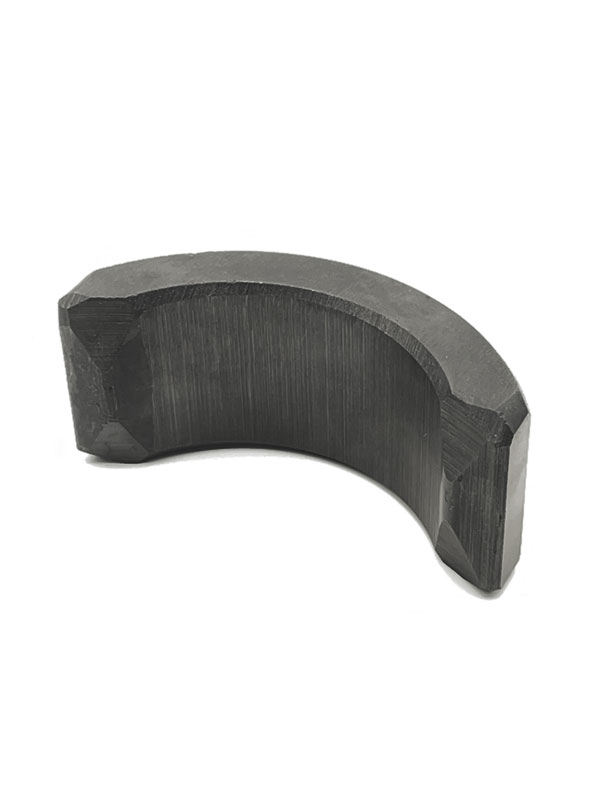
The dominance of this ceramic compound in the fitness industry is not a coincidence. It stems from rigorous engineering requirements designed to survive years of abuse. Here is why it remains the material of choice for drive systems.
Think about the friction generated during a grueling indoor run. Between the belt gliding over the deck and the electrical resistance inside the housing, treadmills generate massive internal heat. Strontium ferrite is uniquely equipped to handle this severe thermal stress. It operates flawlessly at continuous high temperatures, often up to 250 degrees Celsius, without suffering from thermal demagnetization. If a motor used a magnet with a lower heat tolerance, a vigorous marathon training session would cause permanent strength loss. This leads directly to a sluggish, failing machine and expensive warranty claims.
Coercivity defines a material's ability to withstand an external magnetic field without becoming demagnetized. Picture a heavy runner sprinting on a treadmill. Every foot strike creates a sudden massive mechanical load. The motor must instantaneously draw a surge of electricity to maintain the set speed. These sudden electrical surges create strong opposing electromagnetic fields pushing back against the stator. Because ceramic ferrite boasts naturally high coercivity, it easily resists these opposing fields. It maintains its original strength over a decade or more of heavy use.
The economics of the fitness equipment industry heavily dictate component selection. If manufacturers used exotic expensive materials for every internal part, a standard home treadmill could easily cost thousands of dollars more. Because this ceramic is made primarily from abundant iron oxide, raw material costs remain remarkably low. This crucial cost-efficiency allows fitness brands to build large high-horsepower motors delivering industrial-grade reliability at mass-market prices.
Home treadmills frequently face notoriously harsh environments. Users often store them in unheated garage gyms, damp basements, or outdoor workout sheds where humidity levels fluctuate wildly. Furthermore, intense workouts naturally generate sweat, introducing corrosive salt into the machine's immediate vicinity. Because it is an oxide-based ceramic compound, the material is already fully oxidized and naturally rust-proof. Unlike metallic magnets requiring expensive nickel or epoxy coatings to survive, ferrite remains structurally sound for decades in damp conditions.
In electromagnetic systems, electrical conductivity within the magnet itself can be a significant drawback. When a highly conductive metallic magnet experiences rapidly changing magnetic fields, it induces unwanted parasitic electrical currents inside its own body. Engineers call these eddy currents. Eddy currents generate excess internal heat and waste valuable electrical energy. Because ceramic ferrite acts as an excellent electrical insulator, it actively prevents the formation of these eddy currents. Consequently, the energy drawn from your wall outlet converts into rotational torque much more efficiently.
When discussing permanent magnets, many hardware enthusiasts point to Neodymium as the ultimate gold standard. Neodymium offers incredible magnetic strength in a highly compact size. However, stronger does not automatically equate to better when engineering a heavy-duty fitness machine.
In contrast, Neodymium has several severe drawbacks when placed inside a friction-heavy motor housing. First, it is highly susceptible to oxidation and rusts rapidly if its thin protective coating gets scratched. More importantly, standard Neodymium magnets have a remarkably low thermal threshold. They can begin to irreversibly lose their magnetic strength at temperatures as low as 80 degrees Celsius. Given the intense heat generated during a long run, a standard rare-earth magnet would degrade rapidly.
For demanding heat-generating applications, ceramic is definitively the safer and far more economical choice. It rightly prioritizes longevity and thermal stability over sheer compact strength. Below is a direct comparison highlighting why fitness equipment manufacturers choose ceramics over rare-earth alternatives.
Engineering Feature | Strontium Ferrite | Neodymium (Rare Earth) |
|---|---|---|
Maximum Operating Temperature | Up to 250°C (Highly stable) | 80°C - 150°C (Standard grades) |
Corrosion Resistance | Excellent (Naturally rust-proof) | Poor (Requires surface coating) |
Cost Efficiency | Highly economical | Expensive (Subject to raw material volatility) |
Electrical Insulation | High (Prevents eddy currents) | Low (Conductive, generates heat) |
Fitness Motor Suitability | Ideal for continuous heavy load | Not recommended due to thermal limits |
Understanding the specific type of motor inside your equipment provides valuable insight into how these materials function. Direct Current motors are the undisputed champions of residential fitness equipment. They are favored for home use because they operate quietly, cost less to produce, and provide excellent starting torque at lower speeds. The stationary magnets interact seamlessly with the electrified rotor to create a smooth consistent running motion.
In contrast, Alternating Current motors operate on a fundamentally different principle. Typically found in heavy-duty commercial gyms designed to run constantly, AC motors generally do not use permanent magnets. Instead, they rely on electromagnetic induction to create both the stator and rotor fields. While incredibly durable, they require complex inverters, produce more noise, and consume more power. This makes them suboptimal for a quiet home setting.
Looking at the broader manufacturing landscape, the fitness equipment market is experiencing a massive shift toward energy efficiency and smart-home integration. Consumers now demand quieter and more eco-friendly machines. Consequently, motor designers are transitioning heavily toward Brushless DC architectures. Interestingly, this industry-wide evolution does not eliminate the need for ceramics. Rather, it elevates their importance. In a brushless motor, the architecture is inverted. The copper coils remain stationary while the permanent magnets mount directly onto the spinning rotor. This design eliminates physical carbon brushes entirely, drastically reducing mechanical friction. These modern architectures depend on precision-engineered ferrite to deliver high torque with minimal power draw, aligning perfectly with global sustainability trends.
When purchasing a treadmill, consumers frequently fall victim to misleading marketing. Manufacturers prominently advertise peak horsepower in bold letters to make a machine sound overwhelmingly powerful. However, peak horsepower only measures the absolute maximum power a motor can hit for a split second before overheating and failing. The metric that actually matters is Continuous Duty Horsepower. This measures the power the motor can sustain indefinitely without thermal breakdown.
The quality of the internal components plays a massive role in a motor's continuous duty rating and its Revolutions Per Minute. A motor equipped with a high-quality, precisely manufactured Fitness Motor Magnet generates a stronger and much more stable magnetic field. From an engineering standpoint, you should look for specific material grades. For instance, high-performance treadmill motors often utilize Y30BH or Y33 grade ferrite. These grades offer a Remanence Br of 380 to 410 mT and an Intrinsic Coercivity Hcj greater than 240 kA/m. These robust parameters allow the motor to produce high torque at significantly lower RPMs.
Why do lower RPMs matter? Imagine a motor that has to spin frantically at 7,000 RPM just to maintain a jogging speed of 6 mph. It generates excessive heat, wears out the internal bearings faster, and strains the carbon brushes. Conversely, a well-designed motor with robust internal magnets might only need to spin at 4,000 RPM to achieve that exact same belt speed. Lower RPMs inherently mean less friction, a cooler housing, quieter operation, and a significantly longer-lasting machine. When comparing models or sourcing parts, verifying that the motor delivers high torque at lower RPMs is a direct indicator of premium internal magnetic components.
Perhaps the most compelling proof of this material's sheer durability comes from outside the fitness industry entirely. A thriving DIY and engineering maker community exists dedicated to salvaging old treadmill motors. When a machine's plastic frame cracks or its electronic control board inevitably fries after a decade of use, the DC motor itself usually remains in pristine working condition.
DIY enthusiasts frequently extract these heavy-duty motors to build custom variable-speed wood lathes, metal belt grinders, and homemade wind turbine generators. Because DC motors with permanent magnets can operate in reverse, acting as highly efficient generators when spun manually or by wind, they remain highly prized.
The primary reason these salvaged units perform so well in heavy-duty shop tools is because a quality Treadmill Motor Magnet rarely degrades. Even after ten years of enduring the heat, vibration, and electrical spikes of daily running workouts, the coercivity of the ceramic ensures the magnetic field remains virtually as strong as the day it left the assembly line. This secondary market stands as a testament to the industrial-grade longevity that these specific components provide.
You may never actually see the magnets hidden deep inside your treadmill's motor housing. Yet, they remain the unsung heroes of your daily workout. By providing unmatched heat resistance, robust protection against demagnetization, and natural rust-proofing at a highly cost-effective price point, these ceramic arc magnets ensure modern fitness motors remain durable and efficient.
The next time you are in the market for a new piece of fitness equipment or need to source reliable motor components, look past the flashy console screens. Check the motor specifications carefully and prioritize Continuous Duty Horsepower over peak ratings. If you are a manufacturer or repair technician looking to upgrade your motor drive systems, choosing the right magnetic components is critical. We highly recommend exploring professional-grade solutions tailored for fitness equipment. You can find high-performance, precision-engineered magnets that meet strict industry standards directly at Anhui GC Magnet.
No. While almost all residential home treadmills use DC motors equipped with permanent magnets, heavy-duty commercial treadmills found in large gyms typically use AC motors. AC motors rely on electromagnetic induction rather than fixed permanent magnets to generate their rotational force.
It is highly unlikely under normal operating conditions. Strontium ferrite has excellent natural coercivity, meaning it stubbornly resists losing its charge. However, extreme and prolonged overheating, often caused by a severe lack of silicone lubrication on the treadmill walking belt, can theoretically cause slight magnetic degradation due to thermal stress over many years.
It is a permanent magnet manufactured in a highly specific curved crescent shape. This geometric design allows the magnets to perfectly line the circular inner steel housing of a fitness motor. By matching the curve of the spinning rotor, it keeps the magnetic field as physically close to the copper coils as possible. This minimizes the air gap and maximizes electrical efficiency.
Because they utilize strong permanent magnets, a DC treadmill motor can act as a highly efficient electrical generator when spun manually or driven by wind blades. The fixed magnetic field of the internal ceramic induces an electrical current in the copper wiring, allowing users to effortlessly turn mechanical kinetic energy directly back into usable electricity.
Under proper maintenance and normal thermal conditions, the ceramic magnets inside a treadmill motor can easily last 15 to 20 years or more. Their high resistance to demagnetization ensures that the magnetic field strength remains remarkably stable throughout the entire mechanical lifespan of the treadmill.
Yes. If a motor utilizes low-grade magnets that suffer from thermal degradation, the magnetic field weakens. A weaker magnetic field forces the motor to draw significantly more electrical current to maintain the same running speed. This excess current draw generates severe internal heat, which can ultimately cause the motor coils to burn out and fail entirely.
